
Aging as a woman is strange because internally you remain every version of yourself at once.
You are still the girl you once were, carrying all the same memories, insecurities, longings, and private selves forward inside you.
And yet, somewhere along the way, the world begins to look through you instead of at you.
I spent so many years wanting to disappear.
It never occurred to me that the world might eventually help me do it.
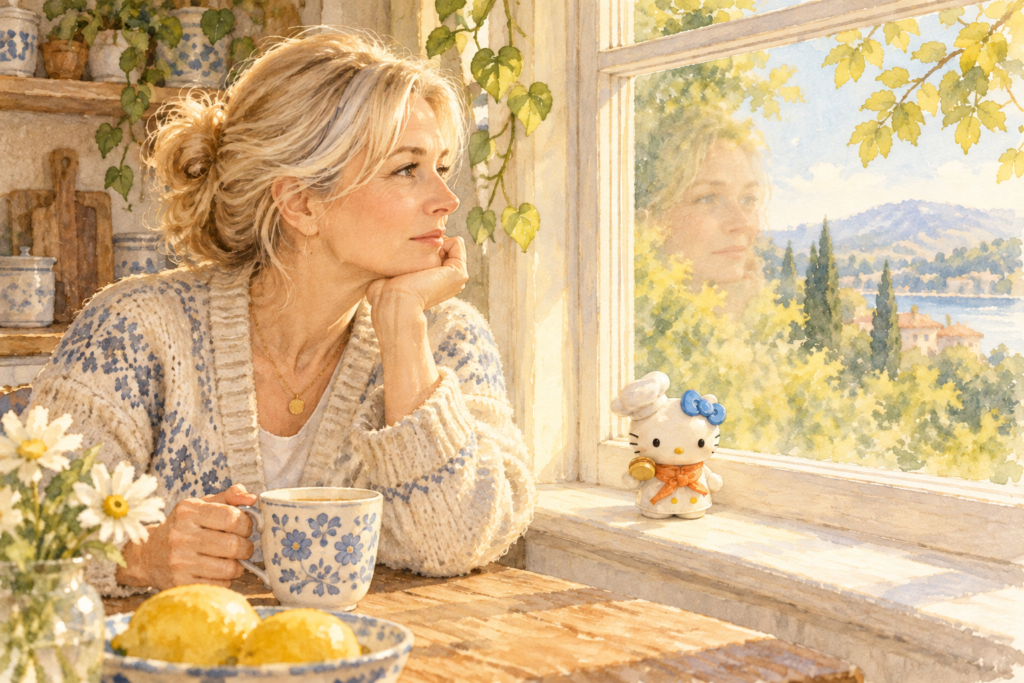
No one tells you that one of the strangest parts of aging as a woman is realizing the world has started relating to you differently long before you relate differently to yourself.
Men seem to age into visibility.
Too often, women age out of it.
There’s a profound physical component to aging that women are rarely allowed to speak about honestly.
And because so much of womanhood has been tied to appearance, these changes rarely feel superficial.
They feel personal.
Women are told from the beginning that beauty is power, even when no one says the words aloud.
Attention becomes a kind of mirror.
We learn ourselves partly through being seen.
The loss is not only external.
It is hormonal, cellular, sensual, emotional.
Skin changes.
Desire changes.
Energy changes.
The body softens in places it once held taut, presenting itself effortlessly toward the world.
The girl you were remains alive inside the woman the world no longer quite sees.
The strange thing is that inside, I do not feel vanished at all.
I feel fuller somehow. More inhabited. More myself.
And yet the world responds differently to me now than it once did.
Perhaps that is the real shock of aging as a woman.
Not the changing face or body,
but the gradual realization that the world no longer mirrors you back to yourself in the same way.
Perhaps aging is not merely decline or disappearance at all.
Perhaps it is initiation.
Another stage of becoming.
Youth teaches women how to be seen.
Maybe aging teaches women how to exist beyond being seen.
Because the mirror is never only literal.
It is attention.
Desirability.
Validation.
A place in the conversation.
The reassurance that we are still seen.
Losing some of that can feel brutal at first.
But it may also force a different kind of emotional development that younger versions of ourselves could avoid.
Not because older women stop caring.
But because eventually there’s no sustainable way to build identity entirely from external reflection.
That may be why the quiet vanishing feels so disorienting.
Not because we cease to exist,
but because the version of ourselves reflected back by the world begins to change before our inner selves do.
And in the end, maybe aging is the slow and difficult process of learning to recognize yourself without the mirror.